Analysis and harmony Semester 1
Lesson 1 Introduction; become acquainted with the topics analysis and harmony 1
1.1 What is analysis, what is harmony.................................................................................. 1
1.2 Analyzing.......................................................................................................................... 2
1.3 Form scheme (Letter scheme)......................................................................................... 4
Lesson 2 Communication about music.................................................................... 6
2.1 Listen and describe what you hear.................................................................................. 6
2.2 From WHAT to HOW; how is the music performed ?..................................................... 8
2.3 How is music communicated towards the musicians, how is it written down?............. 9
Lesson 3 Harmony as an important dimension of Western music......................................... 10
3.1 Music theory and harmony: coding systems................................................................. 10
3.2 Harmony: scale, degrees, functions.............................................................................. 14
3.3 Four part setting (SATB)................................................................................................. 15
3.4 Closing formulas (cadences).......................................................................................... 16
Lesson 4 The first score analysis............................................................................. 19
Lesson 5 and 6 Score analysis continued; Harmony: basic skills four part setting 23
Lesson 7 Another ritornello..................................................................................... 25
Lesson 8 Voiceleading Full cadences...................................................................... 26
Lesson 9 Jazzchords (1)........................................................................................... 27
9.1 Three part voicings (close)............................................................................................. 27
9.2 Four part voicings (close)............................................................................................... 28
9.3 Four part voicings (open)............................................................................................... 29
9.4 Frans Elsen - ‘Jazzharmony at the piano’....................................................................... 30
Lesson 10 Jazzchords (2)......................................................................................... 31
Lesson 11 Binary Form/ Embellishing tones........................................................... 31
11.1 Binary Form.................................................................................................................. 31
11.2 Embellishing tones....................................................................................................... 32
Lesson 12/13 Sonata Form................................................................................ 33
Lesson 14/15/16 preparing the Midterm test.................................................... 33
www.openmusictheory.com = important source of reference
Practical things
Internet and library:
Oxford Music Online (digital version of Grove Dictionary of Music and Musicians)
Lesson 1 Introduction; become acquainted with the topics analysis and harmony
|
Topics: · What is analysis, what is harmony? · Analyzing a music example · Systematic listening and observing; how to create an overview · The importance of patterns and principles · Starting to build a conceptual framework of musical terms |
1.1 What is analysis, what is harmony
Analysis
To put it short and simple: by means of analysis we try to figure out "how music works".
We will concern ourselves in year 1 with Form means and Form principles, structure and texture in music as well as several basic and "iconic" Form characters and Form types.
We will be analyzing with and without scores (aurally).
Musical analysis as a discipline has a relatively short history going back to the late 19th century.
Ofcourse throughout history there have been people have tried to understand music and the principles and patterns behind it, practical (how to compose/write music and how to perform it) but as a theoretical/academic discipline it's very young.
Harmony
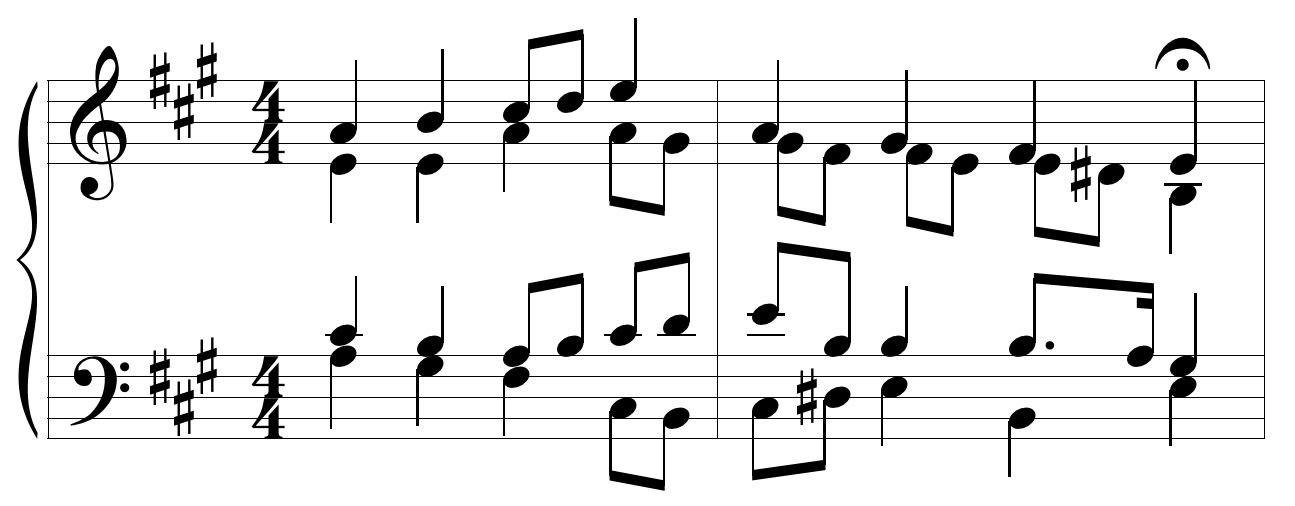
In current western music working with chords or harmonies is one of the key characteristics. During the centuries different approaches were used. The meaning of the term harmony goes back to the Greek harmonia, which had in ancient times primarily mathematical and philosophical connotations. From the seventeenth century until the present day the so called "triad-based music" has been dominant. The theory of harmony developed into a separate theoretical-practical discipline; writing a four-part setting (SATB) in major and minor keys.
Example of such a setting is a Bach chorale:
The most important coding systems which evolved during the last centuries are:
- ·figured bass/basso continuo
- ·degrees (roman numerals)
- ·coding of harmonic functions (in the german theoretical tradition)
- ·chord symbols
The characteristic will be discussed during the coming lessons.
1.2 Analyzing
Patterns & principles: hear & see, listen & watch
When we are listening to music and perceive, recognize and follow things, we are involuntarily and often unconscious structuring our perception. Principles connected with that process of structuring in visual perception have been formulated in Gestalt psychology. Research has shown that those principles apply to musical perception as well.
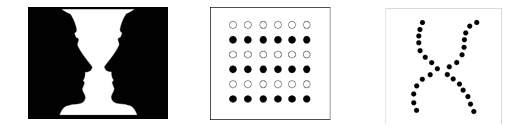
- ·figure-ground (in music: solist and accompaniment, melody and (chordal) accompaniment, the use of rests, ...)
- ·grouping by similarity (in music: strings, woodwinds, brass; chords, motives, ...)
- ·grouping by proximity (in music: register/range, color, chord, motif, ...)
- ·"closure" (in music: rest, cadence, fermata, ...)
See also: https://en.wikipedia.org/wiki/Gestalt_psychology
Music differs from random sounds by unity (coherence) and segmentation.
- ·Segmentation is the way in which music can be divided into smaller parts. You can “zoom” in. Boundaries between parts we call segmentation points. There is a change that makes you aware of something: “I hear something returning, I hear something new”, and so on.
An analogy with language is obvious: For example a poem like a sonnet (4 blocks of text, 14 lines in groups of 4+4+3+3).
A story (for example a detective) has a plot consisting of episodes or stages with different functions. Music unfolds in time just like a story (film, series) and is therefore also a process. Yet we talk about it as if it is a “thing”, an “artefact”.
Form means
Form means: repetition, variation, contrast
Aural analysis can be done by asking a set of general questions. See the working models
You can manipulate a musical idea in three general ways: by repeating, varying, contrasting it (doing “something really different”. Repetition, variation and contrast are the three form means by which you can observe music of all times and places.
Gradually the form/structure of the music becomes clear, which can be visualized for example in a scheme.
Let’s try to apply this with our first listening example.
Music example 1:
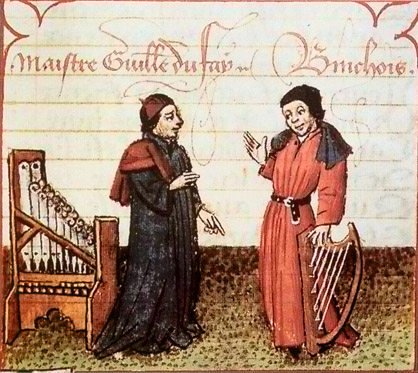
‘Saltarello’ – Guillaume Dufay
Annotated Audacity file

Background info
Some information about the (historical) context of the example:
Guillaume Dufay (1392-1474).
Saltarello. Renaissance. Burgundy. Modal music.
See also: A History of Western Music, the textbook of music history.
Note examples
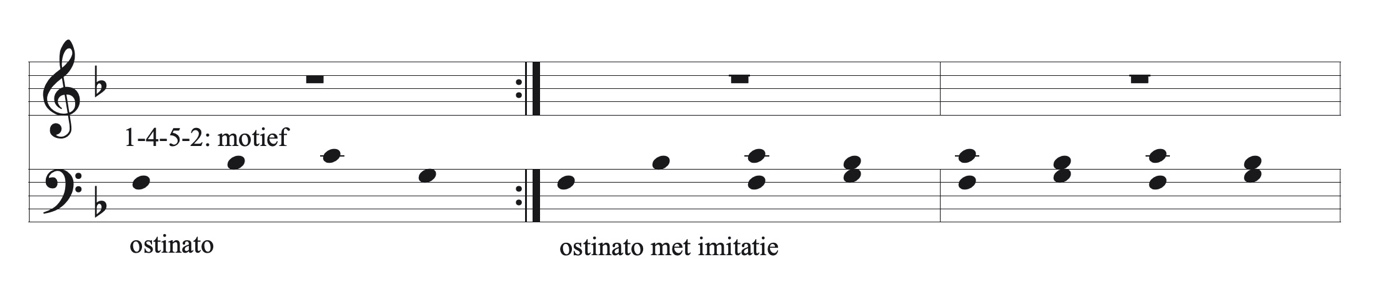
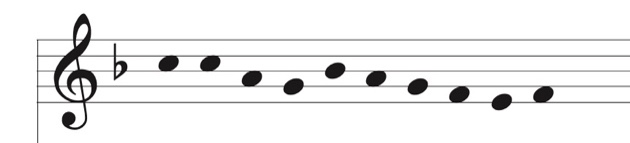
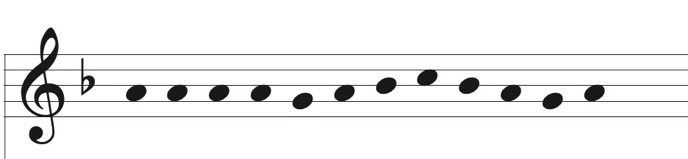
Melody and phrasing:

After listening
1.3 Form scheme (Letter scheme)
We have a sequence of episodes of similar length, without great contrasts.
This is a typical sequential form using repetition and variation as most important form means. There is no real contrast.
Songs and dances almost always have a sequential form as shaping principle.
Sometimes there is a contrasting element, for example a song with verse and chorus (A and B).
Keywords:
Repetition, variation, contrast; unity, segmentation; motif, ostinato, pedal point, imitation; tonality; diatonicism; form, structure, texture; heterophony; form scheme
Read: OMT2 fundamentals ‘Texture’
DIY (do it yourself):
Try to apply what we learned in the lesson with the following two examples:
Music example 2 Spotify link (Dvorak – Serenade for wind in d minor, opus 44)
Music example 3 Spotify Link (Jamie Cullum - ‘Twenty something’)
Lesson 2 Communication about music
|
Topics: · Feedback on music example 2 and 3 · Talking about music; what and how · Texture and parameters · Form characters · Communication about music: performance and parameters · Communication towards musicians (scores) |
2.1 Listen and describe what you hear
Describing musical sound: (working model 08)
In order to be able to talk and communicate about music we need words to describe what's present in the sound. This is about facts. Hearing what is to be heard and putting that adequately into words.
Musical sound can be described in terms of parameters.
NB This process of describing needs to be embedded in the general impression of form/structure and texture of the music.
Texture
Texture is about the relation between different parts/voices in a composition; the "fabric" or "weave" of the sound. Often there is a certain "casting" of participants: (melody with accompaniment, combination of melodic lines, secondary voices/parts, imitation, sequencing and so on).
Read again: OMT2 fundamentals ‘Texture’
Parameters of musical sound
- PITCH (melody, harmony)
- DURATION (pulse, metre, rythm)
- DYNAMICS
- COLOR (timbre)
- LENGTH (articulation)
Cheat sheet musical sound parameters by Wiebe Buis
With regard to these parameters you can ask yourself a general set of questions. For example about instrumentation: do we have a “classical” instrument combination like string quartet, piano trio or something else?[1]
Getting an overview
Making a scheme: (working model 06)
Example of a letter scheme with Audacity (working with label tracks).
Music example 4:
(Patrick Doyle/ Nevilles Waltz audacity)

Music example 5:
Sunrise - Norah Jones
Sunrise (audacity)

In the Patrick Doyle example we recognize the characteristics of a sequencing form; but here is also repetition at a distance and there is a (small) contrasting section. This suggests a balanced form.
The Norah Jones example has the characteristics of sequential form; there an instrumental episode you could call C (at 2”05”), but it really acts like a kind of “bridge” towards the return of B (2’30”)
Form characters / Form types
* The way in which form means are used can lead to three so called * form characters
- ·Sequential form
- ·Balanced form
- ·Developing form[2]
In the musical practice most of the time combinations of these characters occur, with an accent on one of them.
* Examples of Form types are: The fugue, the Sonata form, Rondo Form, Blues form, Ritornello, Song Form.
Music in which development is the most important underlying principle, can be found for example in the (principal) minimal music by Steve Reich:

2.2 From WHAT to HOW; how is the music performed ?
“What happens in the music?” is the central question when we analyze music.
“How is the music performed?” is the central question when we are focusing on aesthetics, quality, tuning, intonation, expression, control of the instrument etc.). In this case you listen as if you are member of a jury.
We are going to compare twee performances of Brahms’ clarinet Trio. We listen to the first 60 seconds of each performance.


Or the comparison of two versions of a jazz standard by jazz musicians.
Misty
fragment 1 Ella Fitzgerald

fragment 2 Erroll Garner

|
Keywords while listening: parameters (5), recognize how they are used, form scheme/letter scheme, layers in musical form, texture |
2.3 How is music communicated towards the musicians, how is it written down?
Examples of scores in different styles and different instrument combinations.
|
Things you should know after lesson 1 and 2: · What are form means · What are form principles · What are form characters · What are form types · What is segmentation · What is texture in music · What are the musical parameters A handy cheat sheet about some of these topics by Wiebe Buis |
Lesson 3 Harmony as an important dimension of Western music
Reread what is written in 2.1 about harmony in Western music
|
Topics:
· Major and minor · Octave division · Circle of fifths · Coding · SATB setting (chorale) · S and B as decisive outer voices · Some harmony keywords such as: function, degree, cadence, voiceleading (rule of the octave |
3.1 Music theory and harmony: coding systems
Most of the time music theory is knowledge by “hind sight”. A certain musical practice is studied, observed, analyzed, discussed and described.
Important music theorists have seen patterns, deduced principles and designed describing/explaining theories.[3]
The idea was to schematize, clarify and very often give practical rules of thumb to handle harmony fluently in daily practice.
There are several coding systems to describe what is happening in the harmony:
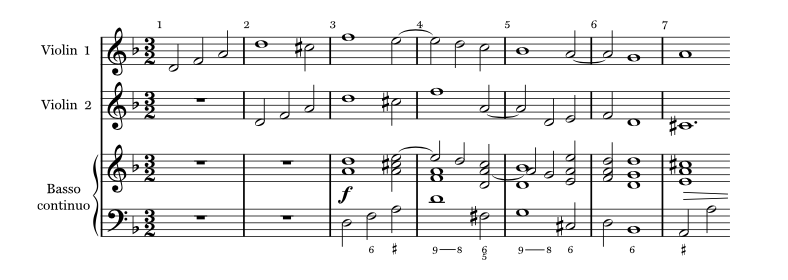
- ·Continuo-notation (inversions and figured bass) from a given bass line the harmony is provided/realized by the continuo player; the desired interval structure above the bass note is
- ·Roman numerals (degrees)
- ·Chordsymbols (Jazz/Pop)
- ·Harmonic function coding (with latters) less important for us.
For a description, see skole.nl)
For us, the first three are most important.
We discuss the following key terms:Circle of fifths, key, pitch collection, degree, function, voicing and voice leading.
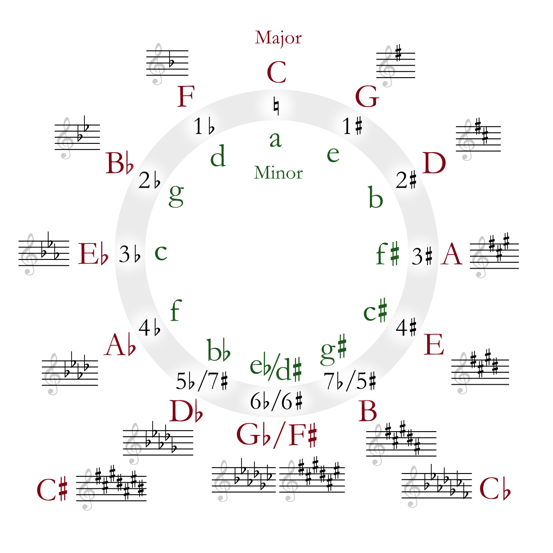
Major and minor keys represented by the circle of fifths[4]
|
Did you know that:
• Key signatures of tonalities appear by making tetrachords, using the architecture of the major scale (1,1,½, 1, 1, 1, ½). The major scale is built by combining two tetrachords • The right side of the cycle are the tonalities a 5th up, the left side of the cycle is a 5th down. • The cycle of fifths is the chromatic scale in 5ths up (C,G,D,A,E,B,F#, Db=C#, …....) • The last key signature in sharp tonalities in the row is the leading tone in the key? • The last key signature in flat tonalities in the row is the fourth tone in the key?
|
|
Dominant chains: • Explanation: Skole.nl • Musical examples: Diatonic: Autumn leaves Chromatic: Bluesette, Cavatina (Theme from The Deer Hunter), Everyday (Bridge) When is there a dominant chain? • The root of the chords that are part of the chain are an interval of a 5th down (or 4th up) apart. • When the chords of the chain are inverted (the bassnote is not the root) and the root of the chords is still a 5th down, it is still a Dominant chain (ex.: C/E, F/Eb, Bb/D etc.......) • The word Dominant refers to the movement of the bassnote a 5th down. That means that the quality of the chords in the chain could be anything. An example of major 7th chords in a chain: Tadd Dameron’s Lady bird (spotify link)
|
Key terms: parallel and relative keys, enharmonic “equal” notes, relations between keys, Dominant chain
Example continuo (Corelli)
Reading material Open Music Theory:
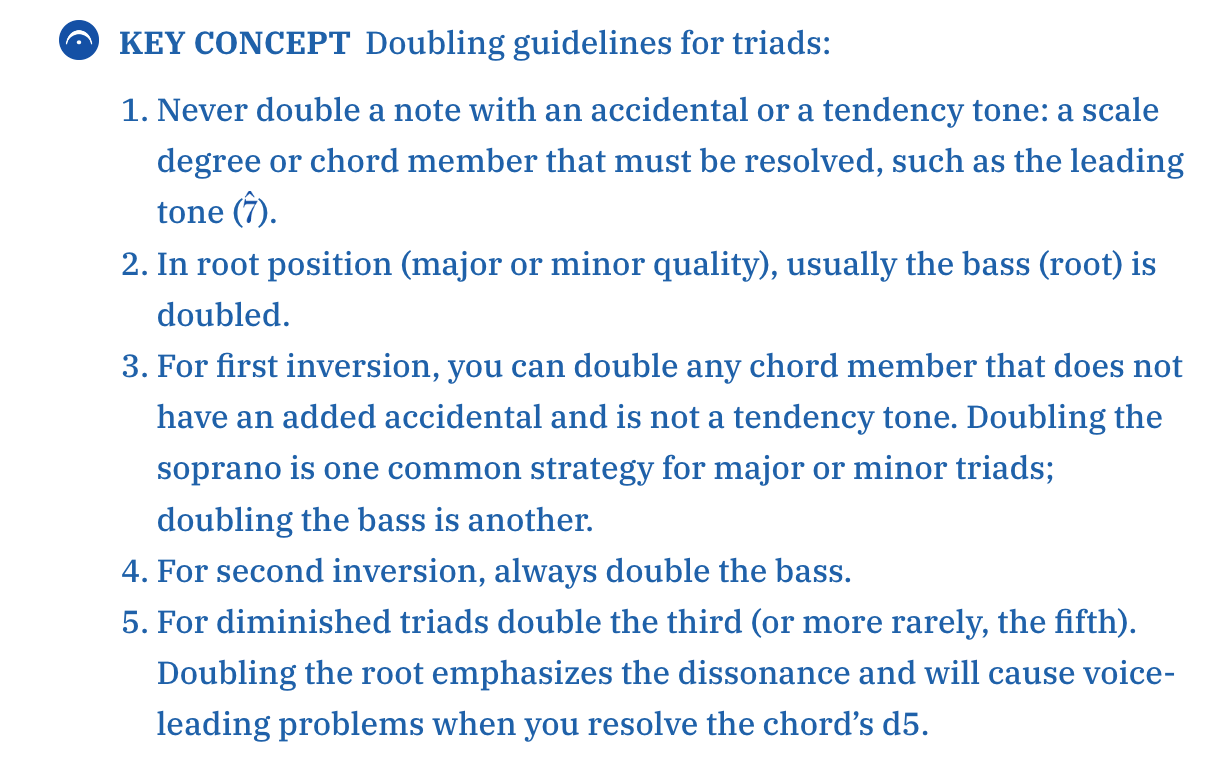
Class exercises:
Class exercises:
3.2 Harmony: scale, degrees, functions
The origin of harmony, degrees and functions:
- ·Jean-Philippe Rameau - Traité de l'harmonie 1722 (see AHWM chapter 18 from pg.423)
- ·Heinichen - der General-bass 1728 (kwintencirkel)
- ·Gottfried Weber (roman numerals)
- ·Wilhelm Maler/Hugo Riemann (Function coding)
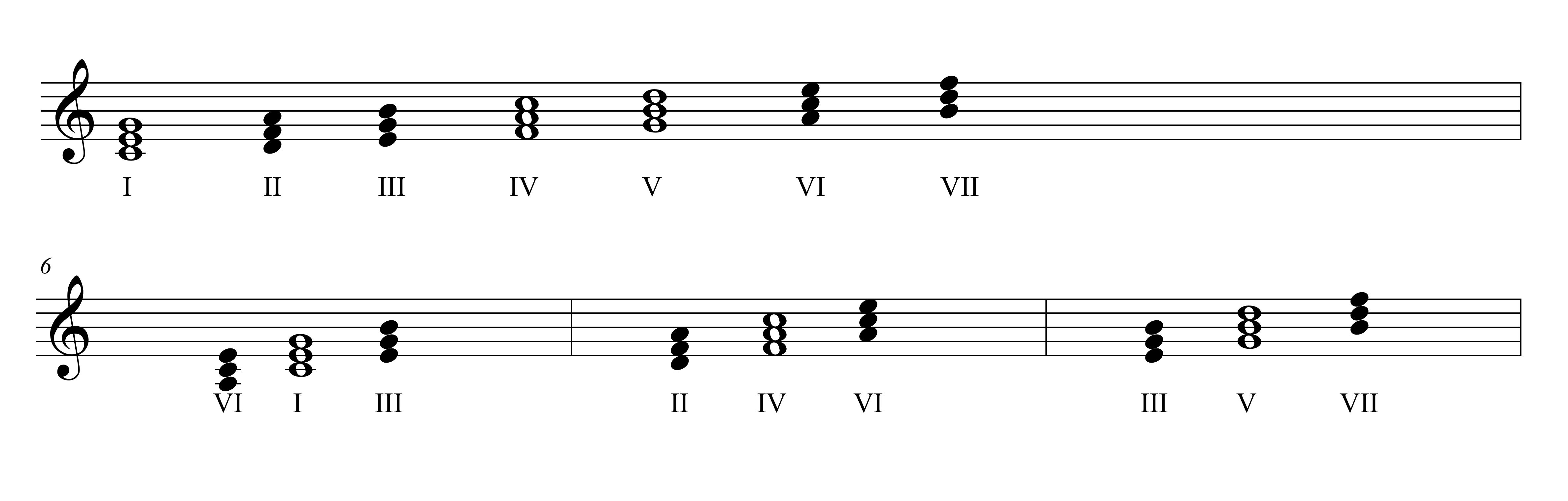
Scale, triads,, harmonic functions
Primary and secondary triads; three functions, seven degrees.
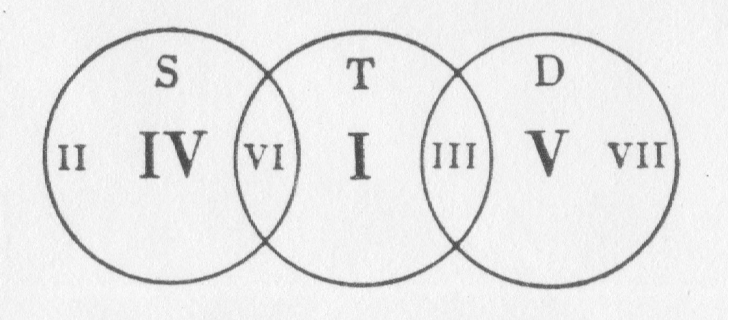
T = Tonic
S = Subdominant (also called PD or PreDominant)
D = Dominant
In C major: open notes are primary triads, closed notes are secondary triads.
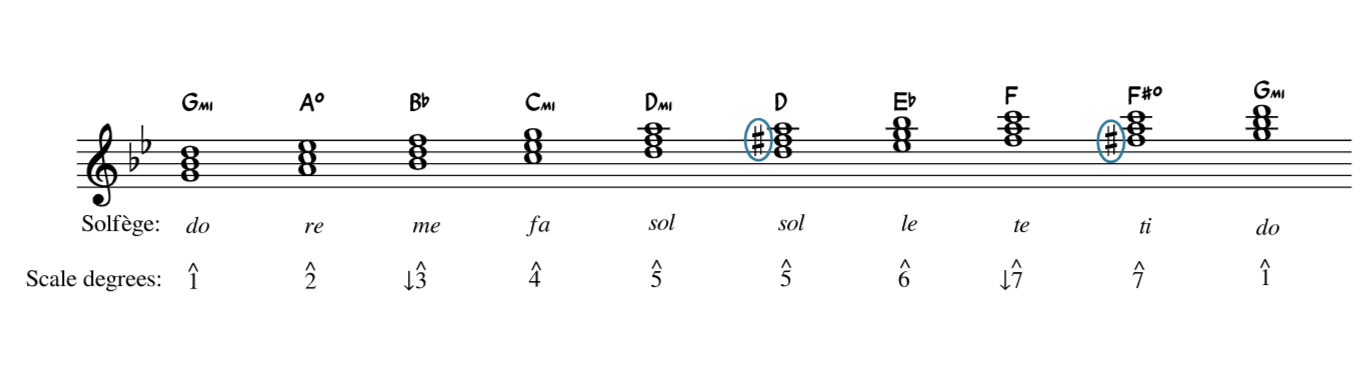
Remark about minor
Minor is a scale with 9 instead of 7 notes…
In too many theory books minor is presented as being a scale with three variants. This may be “theoretically” correct but is not in line with musical practice of music from the common practice era.[5]
Melodic movement from 5 to 8 (ascending) and 8 to 5 (descending) can be realized as:
5-#6-#7-8-7-6-5.
So depending on the context 6 and 7 can change.
Of course this has consequences for harmony.
Figuur 1 Source: OMT 2
3.3 Four part setting (SATB)
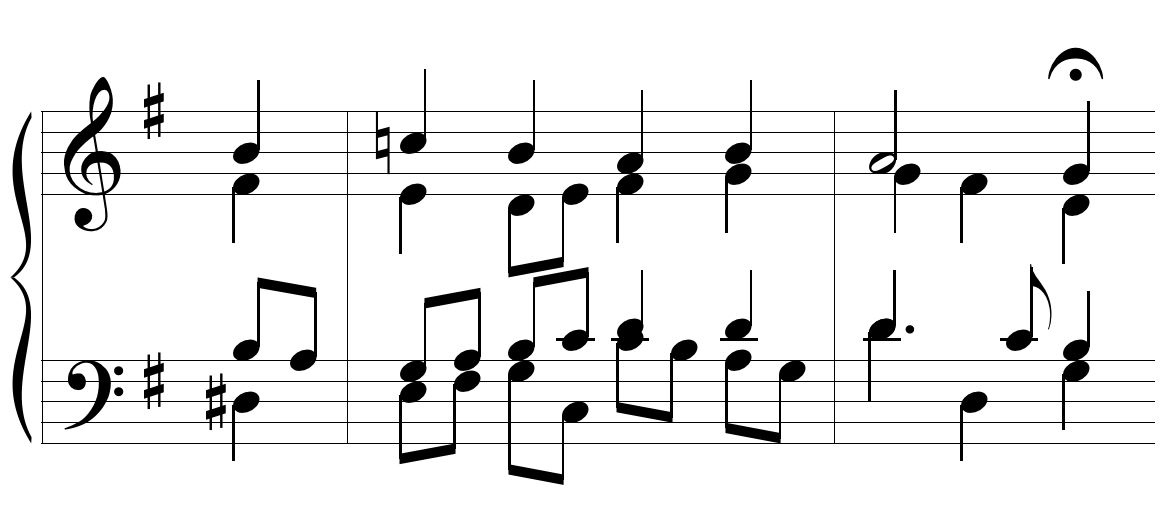
Some lines from Bach chorales:
In major
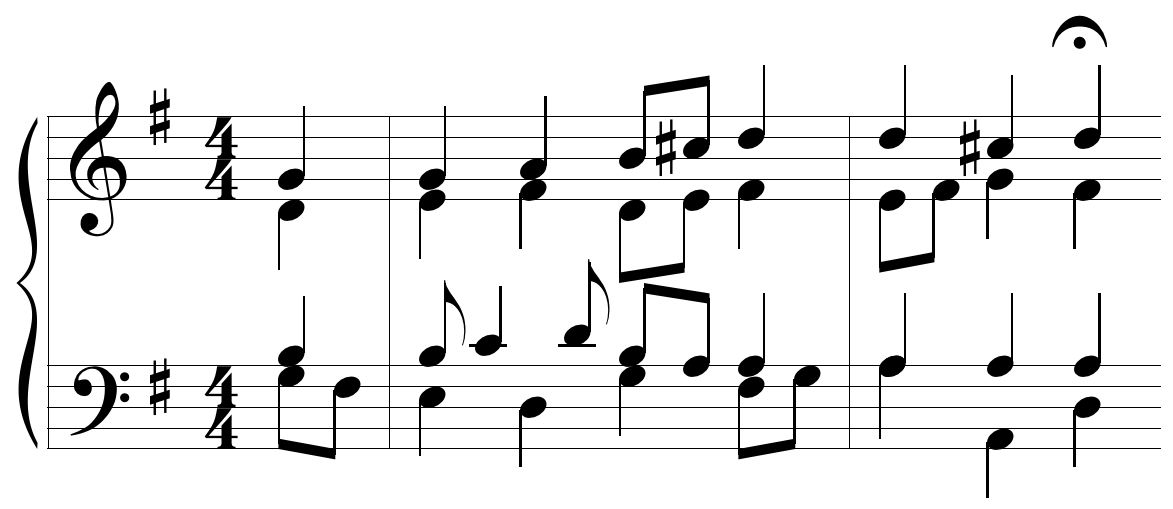
"Brich an du schönes Morgenlicht". (link to skole.nl)
In minor
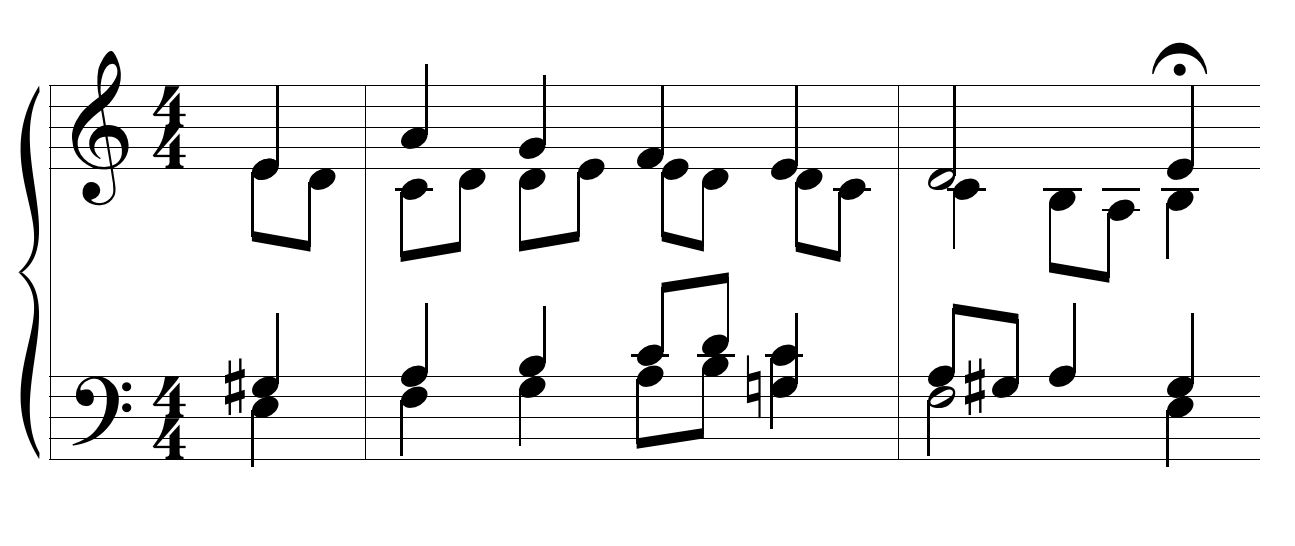
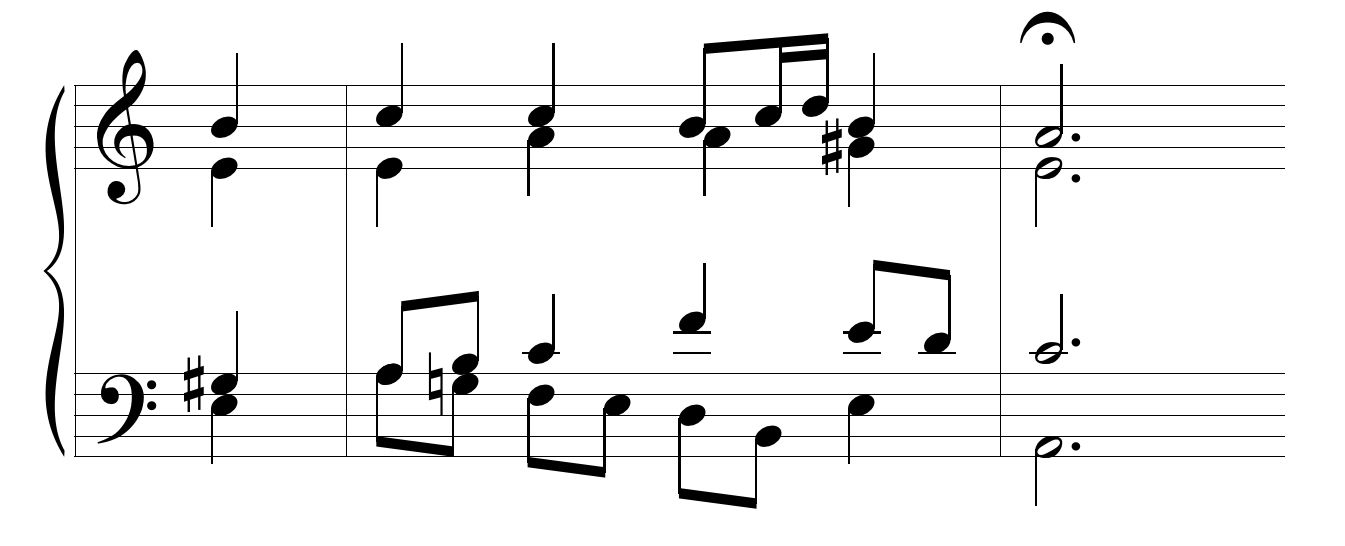
Wie soll Ich Dich empfangen (link to skole.nl)
General observations: outer voices (S and B) are main role players.
Steps/skips?
Dissonances?
3.4 Closing formulas (cadences)
Cadences have an important function in Bach chorales. In a Bach chorale you find them at the end of each line.
They are indispensable for articulating the tonal structure of a composition.
Outer voices are determinative for the working of the cadence.
Cadence types: authentic, plagal, complete, half cadence
I-V-I; I - V7 - I
I-IV-I
I-IV-V-I
Ending op V (halfcadence)
Nice source reading
Early music resources:
Cadences in the 16th and 17th centuries
Representation of functions by degrees
Several chords can fulfill one function (D: V en VII; S: II en IV; T: I en VI)
S-D-T can be:
I-IV-V, I
II6 – V - I
II (7)– V(7) – I(add6) (jazz)[6]
Chord scheme, chord progression
Chord scheme as the background framework of a composition.
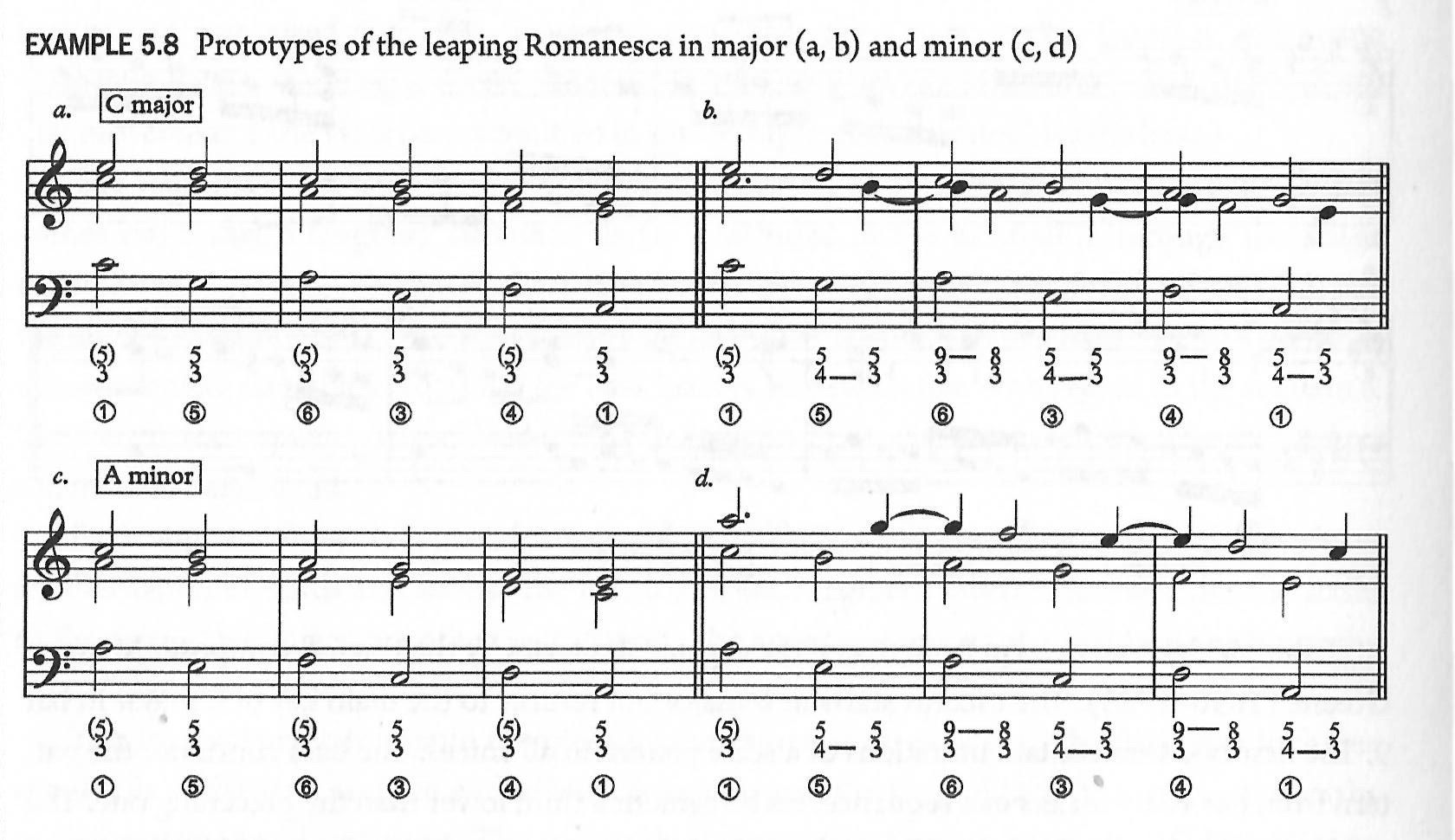
- ·Famous partimento patterns (chord schemes as the background of a composition)
- ·Rule of the octave, two part realization, 3 part realisation
Music example: Pachelbel - Canon (Romanesca): I-V-VI-III-IV-I-IV-V
Stepwise Romanesca with stepwise descending line in the bass..
|
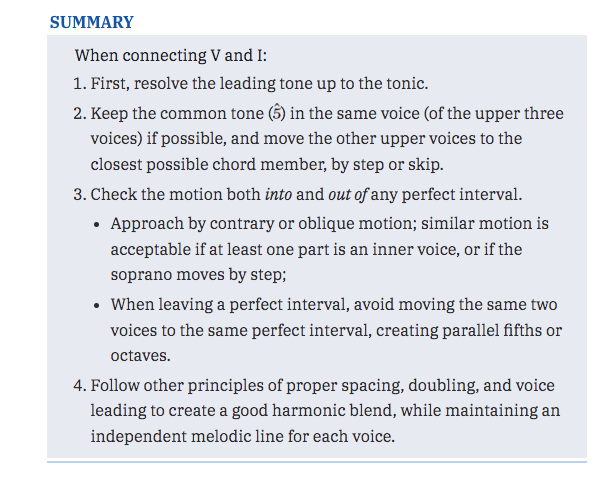
Things you should know after lesson 3: · How does continuo work and what are the correct chordsymbols · Learn the circle of fifths by heart · Roman numerals and harmonic functions in major and minor · Different Cadence types · How to recognize Dominant chains · How to voicelead I and V in major and minor |
Lesson 4 The first score analysis
|
Topics |
Analysis |
Harmony |
|
Concerto en Ritornelloform (Zie ook AHWM 22) |
Texture And texture patterns |
Chordsymbols Continuo notation Harmonic degrees (figured bass) Modulation, tonal structure |
|
Short content: · Ritornello form as our first form type (Vivaldi) · Vivaldi: continuo and additional parts (no conductor no score) · patterns: sequence, chain of dominants, motif and variation, cadence, modulation · role playing: melody/bass/harmony: texture · Coding: basso continuo, roman numerals, chord symbols
|
Summary of the usage of figured bass
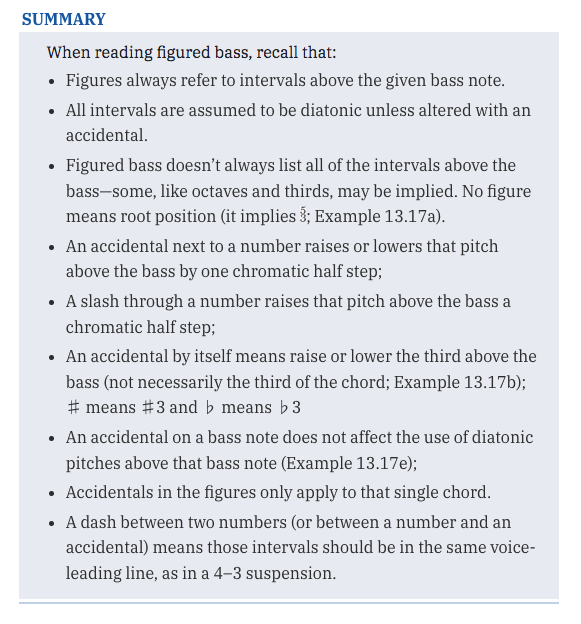
Reading material from OMT2:
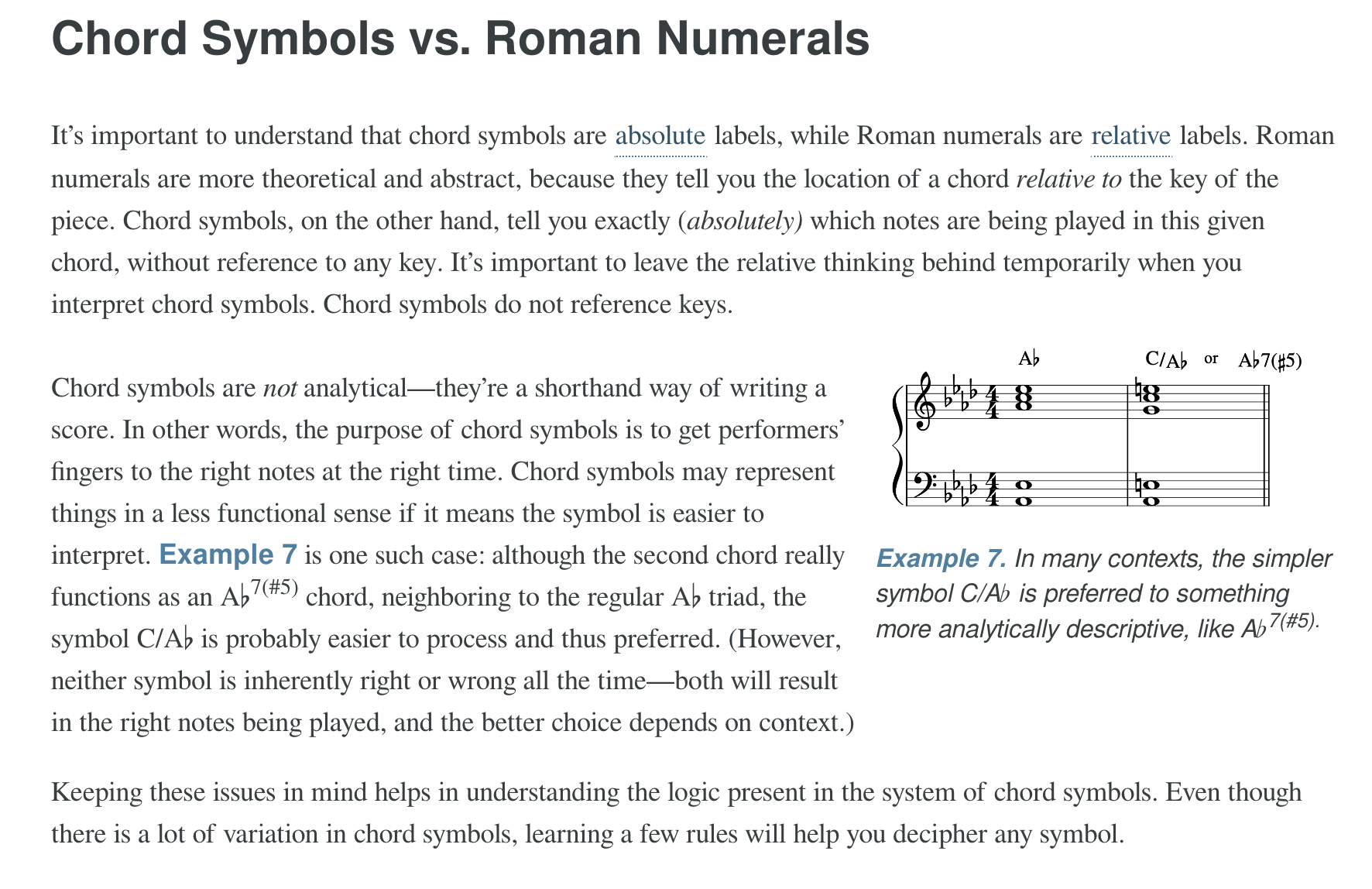
Additional video material: www.earlymusicsources.com;
early basso continuo (1600 - 1650)
Italian basso continuo (1650 - 1700
Analysis: Concerto Antonio Vivaldi (Estro Armonico VI a minor RV 365)
Later: published in score form (19e eeuw).
Link to PDF
Link to Spotify
Timeline (not available)
|
Things you should know after lesson 4:
· What is a Ritornello · Are you able to read the score relatively fast? · No?, go to Artusi and work · Can you define the chordsymbol when you see a Figured bass in the Vivaldi score and can you name the related harmonic degree · Can you aurally recognize cadenses, sequenses and dominant chains in a certain timeframe · Can you notate the correct analysis info about cadenses, degrees and chordsymbols · Do you see modulations in the score |
Lesson 5 and 6 Score analysis continued; Harmony: basic skills four part setting
|
Topics |
Harmony |
|
How to “voice” a chord (vertically): open/closed position Four-part setting and voice leading Types of motion |
Common tone The parallel fifth/octave |
Open Music Theory 2:
Introduction to harmony, cadences and phrase endings
Strengthening endings with V7 (Voiceleading V-I)
Aldwell & Schachter: (I – V exercises)
Lesson 7 Another ritornello
Class exercise: E majeur uit Estro Armonico
Recognize the Vivaldi approach in another Concerto. (E major)
Link to PDF
Link to Spotify
Lesson 8 Voiceleading Full cadences
Open Music Theory 2:
Strengthening endings with strong predominants
(Voiceleading Subdominant-Dominant-Tonic)

Opt.: Working with Audacity
Lesson 9 Jazzchords (1)
The amount of voices that are used to voice jazzchords can differ. The way that the voices are spread are called voicings. Musical terms that declare the type of voicing are: close, open voicings, drop 2, drop3, drop 4, drop 2&4 and spread voicings. We will get into that later on. Let’s look at some possibilities:
9.1 Three part voicings (close)
The most basic voicing is (1-3-7 or 1-7-3)
Play the root in the lefthand and the third and seventh (the so called guidetones) in the righthand. (two possibilities: the 3rd up or the 7th up)
The connection (voiceleading) of the bass and 3 and the 7 between the chords should be:
1) Bass moves according to the chordsymbol (in a II-V-I cadence a 5th down)
2) Keep the common tone between the chords
3) The other voice moves stepwise
4) If there are no common tones, both 3 and 7 move stepwise if possible
Let’s use these guidelines to voice the cadence most used in Jazzmusic, the II-V-I.
When you can voice this cadence, you can voice almost any Jazzstandard.
Example 1 in Major:

Example 2 in minor:

9.2 Four part voicings (close)
When you want to make the 3 part voicing sound more richer, Jazzier so to say, There are several possibilities for the 4th voice. You should try out different combinations.
The 4 th note could be a chordtone or a tension. Let's have a look.
The three part voicing example mentioned above (Ex. 1) could look like this when adding a 4th note in the right hand.(ex. 3)
Ex. 3 in major

1) The added 4th note on the Ebm7 is the 5th of the chord (the Bb)
2) It makes the sound more steady and full, although the 5th is a neutral note with little colour
3) The added note (Bb) becomes 9 on the Ab7 and is the common tone between Ebm7 and Ab7, and resolves to the 5th of the Dbmaj7.
4) Voiceleading Ebm7-Ab7-Dbmaj7;
Soprano: 3-7-3
Alto: 7-3-7
Tenor: 5-9-5 (added 4th note)
Bass: 1-1-1
5) Instead of choosing the 9 on the Ab7 chord we could change that note to a b9 or possibly a #9. Later on we will discuss Tensions in depth.
N.B.: We could have chosen the Ab in the tenor on the Ab7 chord but then there would be a double Ab in the chord. The 9 provides a nice colour and makes it more jazzy.
The 9 is called a tension. When using a tension it replaces the next lowest chordtone.
- • 9, b9, #9 replace 1
- • 13, b13 replace 5
In minor it would look like this:
Ex. 4 in minor

When using 4 part close voicings there are 3 soprano lines possible:
The 3,7 or extra 4th note. You should try them all out on the Standard of the week
Classexercises:
9.3 Four part voicings (open)
The difference between close 4 part voicings and open 4 part voicings is the way the voices are spread. In example 1-4 the upper three voices are close together, all in the righthand.
The moment you take one voice and put it an octave lower, the voicing changes from close to open, in this case a drop 2 voicing. These voicings are played by 2 voices in the left and 2 voices in the righthand.
Ex. 5 Drop 2 voicing in major

Ex. 6 Drop 2 voicing in minor

NB: notice the difference between the sound of close and open voicings!
9.4 Frans Elsen - ‘Jazzharmony at the piano’
A book about pianovoicings and practical harmony that is outstanding and developed by Frans elsen with a lot of Barry Harris influences is ‘Jazz harmony at the piano’. We will cover a couple of chapters in class. Considering the voiceleading of the II-V-I progression the following chapters go in detail on voicings and very important the lines you can make using different combinations of tensions. Don’t forget to play the examples and use them. Remember: theory doesn’t stand alone but is always is a tool for making music!
Chapters on voiceleading the II-V-I;
- ·Primary degrees in jazz
- ·V-I with some chromatics
- ·Subdominant – Dominant and the II-V-I progression
- ·Subdominant – Dominant – Tonic and the II-V-I profgression
- ·A few rules for Voiceleading.
- ·Some tips for chord voicing
Lesson 10 Jazzchords (2)
This week we look at different open voicings and techniques to use them in different situations.
Classexercise: Let’s see if we can make voicings on reharmonized Blues tunes, using the following file
This christmas song aranged for guitar has different open voicings. Try and make the voicings or analyse them.
A great site to look at the usage of different techniques and voicings is Bushgrafts of pianist Dough Mckenzie
Lesson 11 Binary Form/ Embellishing tones
The next couple of lessons we will go back to Form in classsical music. After our analysis of the Ritornello form it’s time to look at other important forms such as Binary Form and the Sonata Form. It’s important to see the relationship and evolution between Binary and Sonata form.
11.1 Binary Form
The chapter that we dive into comes from the site ‘Open music theory’ called Binary Form.
Read this chapter carefully.
Another example of a composition in Binary Form:
Allemande from lute suite no 1 – J.S. bach
An example (pdf) of a Simple Binary form with a balanced aspect: Domenico Scarlatti’s Sonata in A major, K. 322 (Example 8), look at the annotations about the balanced aspect (X). (audio in OMT chapter Binary form, example 4)
11.2 Embellishing tones
- A)Embellishing tones In classical music
An important tool for analysing harmony is knowing which notes are part of the main harmony of the moment and which notes are so called embellishing tones.
Keywords in this OMT chapter on embellishing tones:
Passing tone, neighbouring tone, appogiatura, anticipation, suspension........
Read this chapter first!
A great dissertation with audio on this subject is on Skole.
- B)Embellishing tones In Jazz
In Jazz, ornamentation is a great improvisation and composing tool. Let’s look at a famous Jazz melody and derived from that, a BeBop theme. Try to figure out the embellising tones of how high the moon and the Bebop variant based on the melody of How high the moon, ‘Ornithology’, a composition by Charly Parker.
In this version, sung by Patti Austin, both songs are combined in one arrangement.
An example of embellishing a chord pattern step by step (audio)
Keywords in Jazz referring to the subject of Embellishing tones are:
Chromatic approach, passsing tones, enclosure, chordtones (on strong beats)….......
Classexercises:
- ·Find and name embellishing tones of these excerpts of Bach chorales (annotated)
- ·Analysis of form, harmonic progressions, cadences, modulation and embellishing of the Allemande French suite no 2, bwv 813 – J.S. bach
(annotated version is here)
Lesson 12/13 Sonata Form
The topic of Week 50 and 51 will be ‘The Sonata Form’
We will be looking at the different sections of the Sonata and the segmentation of each section into smaller units.
- ·History of the Sonata form and the development from the Binary form to Sonata form; AHWM Ch. 22 slides
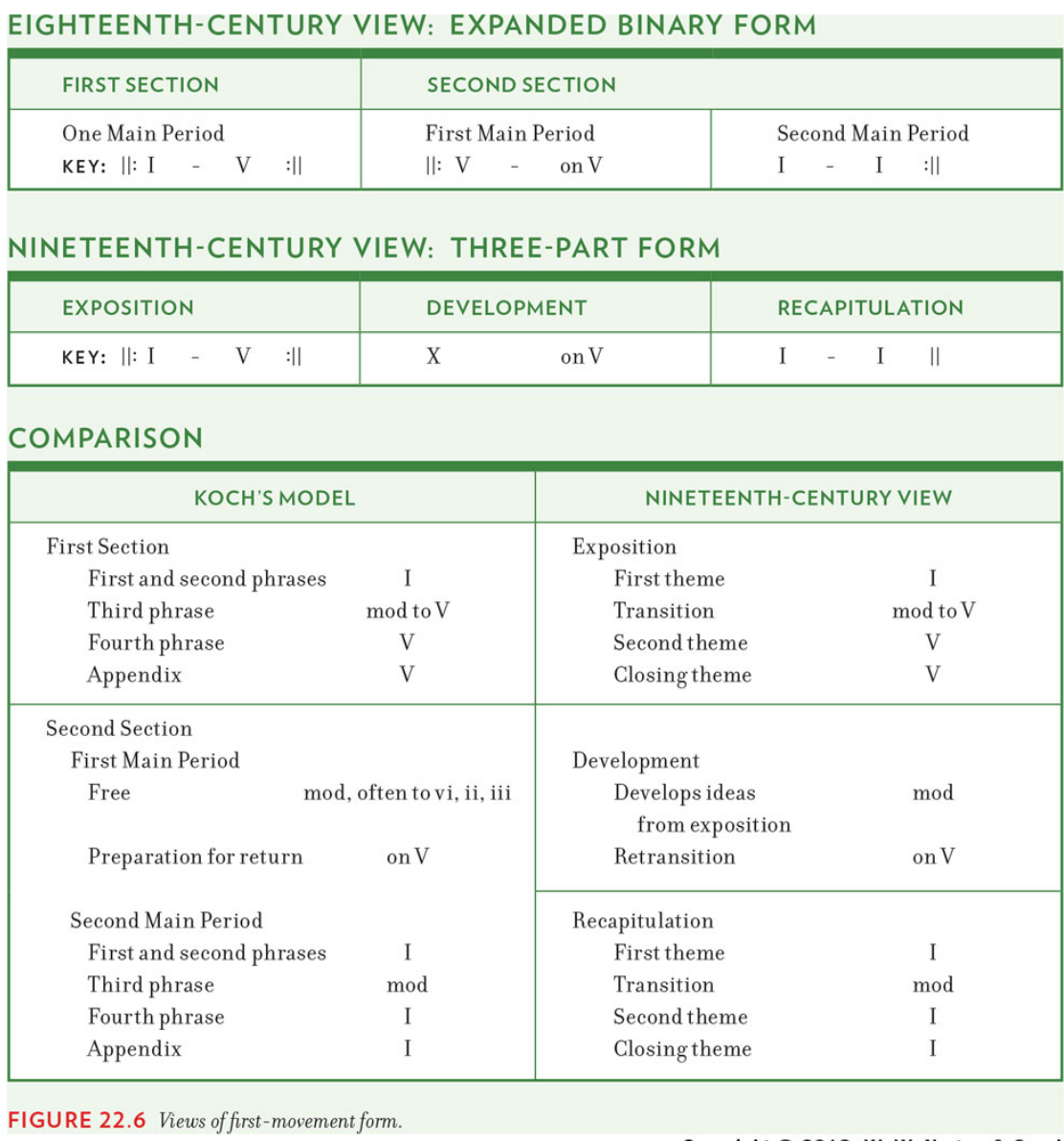
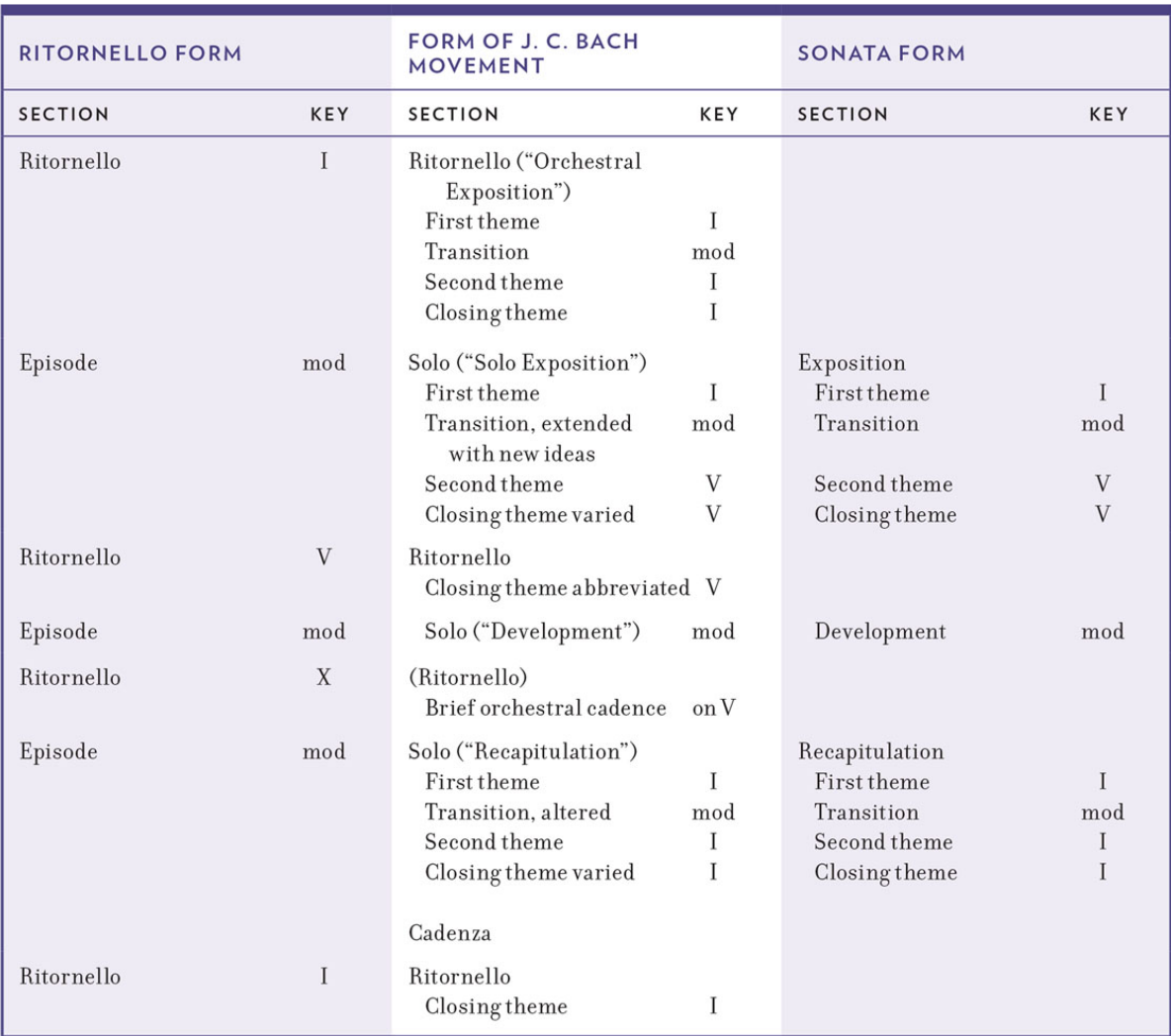
Similarity in form of The Ritornello and the Sonata Form
- ·Read the OMT chapter ‘Sonata form’
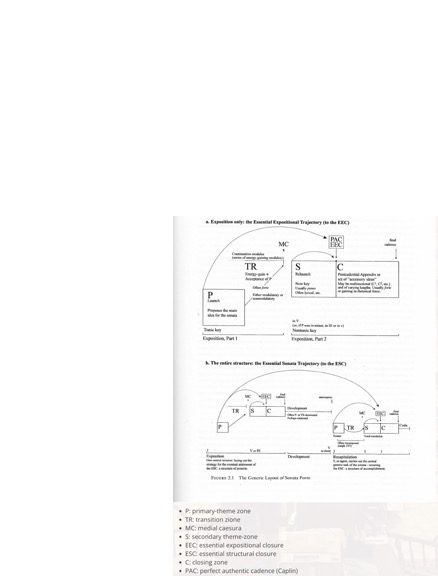
A schematic overview of the Sonata form by Hepokoski J. A. & Darcy W.
- ·Next step is the analysis of the Beethoven Sonata opus 14 op.14 nr. 2 (part 1) with the basic theory in mind. We will be looking also at cadences, sequences, dominant chains, pedalpoints, imitation and modulations
Analysis Sonata (By Wiebe Buis)
Lesson 14/15/16 preparing the Midterm test
In these three last lessons of the first semester we will recap all the topics that we discussed in semester 1.
We will also practice the analysis on another Ritornello and a Sonata Form.
Classexercises:
Practice scores (exam practice):


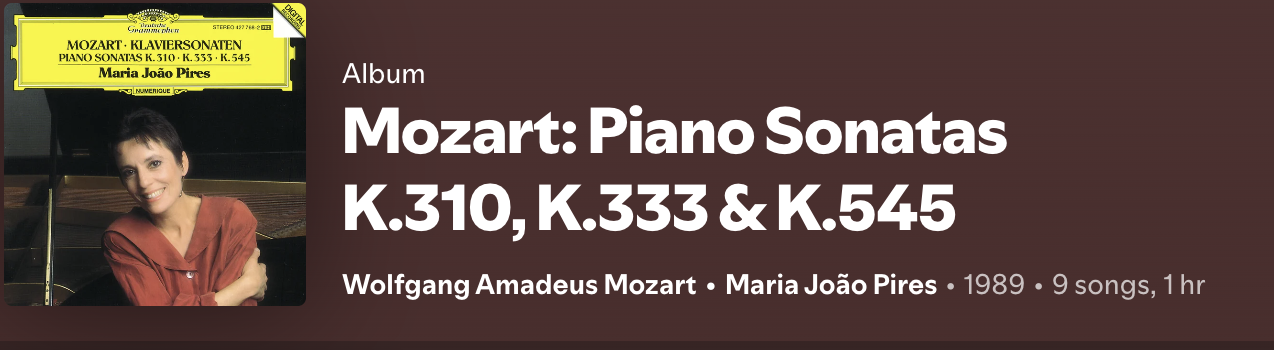
- ·W.A Mozart
Sonata Nr. 8, KV 310, pdf
Classical Voiceleading exercises (exam practice):
Voiceleading full cadences (exercises)
Voiceleading full cadences (results)
Week 5, Analysis and harmony Formative midterm test
[1] See for the questions skole.nl
[2] Seefor defintions skole.nl
[3] The most famous example perhaps being Rameau and the music by Corelli (see als AHWM).
[4] Origin: Johann David Heinichen (1683-1729)
[5] Also in OMT 2 unfortunately…
[6] Frans Elsen voorbeelden? Site Leon week 43.